Work styles are your usual preferences for planning, doing, and sharing work. To identify yours, review a real week of tasks, look for repeated patterns, and test an adjustment against the work you need to finish.
You might prefer independent work for drafting, collaborative work to resolve a disagreement, and a checklist before sending the final version. Independent, collaborative, structured, flexible, supportive, and creative preferences can overlap in one person. You do not have to choose a single label. Start by understanding the preferences, examine how you worked during an ordinary week, then choose an approach and test one small change.
Work Styles Describe How You Approach Work
A work preference shows up in choices you make: how much autonomy you want, when you seek input, how much detail you need before starting, and how you respond when requirements change. The table below describes common ways of working. Treat them as useful groupings for noticing patterns, not as boxes you have to fit.

| Work Style | What You Tend to Prefer | Where It Helps | Friction to Watch For |
|---|---|---|---|
| Independent | Ownership and uninterrupted time to carry work forward | Drafting or analysis that has a clear owner | Feedback arrives late, or other work depends on something you have not shared |
| Collaborative or cooperative | Discussion and shared problem-solving | Decisions that need several perspectives | You wait for input or keep discussing after a decision is needed |
| Structured or detail-oriented | Clear steps, standards, and checks | Accurate, repeatable work | You spend too long refining details that have little effect on the result |
| Flexible or adaptive | Room to change the sequence or respond to new information | Work with shifting requirements | Priorities drift, leaving tasks unfinished |
| Supportive | Attention to relationships, handoffs, and practical help | Coordinating work and helping others move forward | You accept requests without checking existing commitments |
| Creative or idea-oriented | Exploring possibilities and making connections | Developing options or finding a new direction | You open new paths before finishing the one you chose |
You may see lists that describe four work styles, but the number depends on the framework. Different frameworks group working styles in different ways, so there is no single count to use as a standard. The practical question is which approaches you choose and when they help you do the work in front of you.
Some preferences overlap but describe different choices. Collaboration is about working through something together; support is about helping others proceed. Structure concerns process and detail; independence concerns autonomy. You can, for example, prefer to prepare a structured draft alone, then ask colleagues to discuss an open decision.
As you read the descriptions, notice which preferences appear in your own work. Look for combinations, too: you might enjoy generating ideas with others, then want quiet time to shape them into a careful plan.
Find Your Work Style in a Real Week
Choose a recent, ordinary workweek and review about six tasks. Include solo work, shared work, something routine, and something uncertain. The goal is to spot choices you repeated, not to label yourself from one unusually good or difficult day.
Use evidence you already have: your calendar, completed task list, drafts, and message threads. If those records do not show how you approached the work, collect observations as you go through the next week. For each task, note what you chose and what the situation required.
Copy this template once for each task:
- Task and Intended Result:
- What the Task Required:
- How I Planned:
- How I Started:
- When I Sought Input:
- How I Finished:
- What Helped:
- What Got in the Way:
- Preferred Approach:
- Required Approach:
Keep the last two prompts separate. If a meeting was mandatory, attending it does not by itself show that you prefer collaborative work. Note whether you chose to discuss the problem, needed the meeting to get information, or would have preferred another way to reach the same result.
Look for specific actions. Writing a checklist before starting may point to a preference for structure. Drafting before asking for comments may show that you like to prepare independently. Talking through an unclear problem may suggest that collaborative exploration helps you get started. Record what happened, rather than guessing at a personality trait.
When you have reviewed the tasks, underline choices that appear more than once, especially across different kinds of work. Identify the preference you returned to most often, a second preference, and the conditions where each one helped. For example, you might work best independently when drafting, but seek discussion when a decision depends on information held by several people.
Summarize your notes in this sentence:
I usually prefer ___ when ___, and I work better with ___ when ___.
If the evidence points in two directions, keep both preferences in your summary or observe another week before choosing. A pattern can depend on the task and its conditions. If you want another set of questions to compare with your notes, try the productivity style quiz.
 Loggd · by the makers of this blog
Track your habits, tasks and goals in one free app.
Every day you check off fills in a grid of your last 365 days, so you can see if you are getting better.




Free plan with no time limit. No credit card.


Separate Preference From What Is Getting in the Way
Before changing how you work, find the exact point where the task gets difficult. Is it understanding what is needed, getting started, finding information, handling interruptions, coordinating a handoff, or finishing? Naming the friction gives you something specific to address.
A preference is an approach you repeatedly choose when you have suitable resources and reasonable freedom to choose. A skill gap can look like a preference at first. If you avoid a spreadsheet because you do not know how to use a formula, learning or practicing that formula may help more than deciding you dislike detailed work.
Workflow problems also affect how a task feels. Waiting for approval, lacking a clear owner, or receiving conflicting instructions calls for a clearer process. Repeated interruptions while drafting may call for a protected work period or a different setting before you decide that independent work does not suit you.
Workplace conditions can cause stress, strain, or interpersonal problems, so examine the conditions around the task as well as your response to it. Too little sleep can make it harder to concentrate or remember things, so compare demanding days with days when you are better rested.
Try one practical adjustment, then observe the same kind of task again. Clarify missing instructions, learn a missing skill, or change an environmental factor you can control. If the obstacle is where information and tasks live, use this guide to choose work productivity tools around the work you need to do. If you face persistent overload or unclear responsibilities, discuss priorities and expectations with the person assigning the work.
Choose Your Approach for the Task in Front of You
Start with what the task requires. Identify the intended result, who has the information you need, how costly an error would be, and whether the requirements are settled. Then choose a starting approach that fits the work, and change it if the task calls for something different.
| Task Situation | Starting Approach | Practical Action | When to Change Approach |
|---|---|---|---|
| Drafting or analysis with clear ownership | Work independently | Make a draft or finding, then ask for review when another perspective would help. | Bring in a collaborator if you uncover a decision or dependency you cannot resolve alone. |
| A decision that depends on several people | Collaborate | Surface constraints, record the decision, and assign a clear next owner. | Move to individual work once the group has settled the open questions. |
| Repeatable work or a high cost of error | Use structure | Follow a clear sequence and check the result against requirements. | Revisit the sequence if the requirements change. |
| An uncertain brief | Stay flexible and explore ideas | Compare options, choose a direction, and define what you will deliver. | Add structure once the direction and expected result are clear. |
| A blocked handoff or competing needs | Use a supportive approach | Clarify the need and agree on ownership without automatically taking over the task. | Ask for a decision about priorities if the work cannot proceed as agreed. |
One task may need several approaches in sequence. For example, explore options together, draft alone, check the draft against requirements, then coordinate delivery. A large assignment can feel easier to start when you turn the longer-term goal into small, attainable steps, then choose an approach for the next step.
When several tasks depend on one another, use the project work plan template to make those dependencies and owners explicit. Keep the plan focused on the decisions you need to make now.
Give Your Preferred Style a Helpful Daily Habit
Choose one habit that addresses friction you noticed in your task review. Try it on the kind of work where it is most useful, rather than changing every part of your routine at once.
Independent Work
When someone else depends on your progress, send a brief update at an agreed point: what is done, what comes next, and where you need input. Ask for review before beginning a dependent task, so a missing decision does not hold up the next step.
Collaborative Work
Before a discussion, collect the questions the group needs to answer. End by recording the decision and its owner, then protect a solo work period to act on it. Task-switching experiments found that people lost time when switching tasks, with larger losses on more complex tasks. When your role allows, group message checks around demanding solo work rather than interrupting each task to check them. If you need help giving that solo period a clear start and finish, use the focus timer guide to set up a session around one task.
Structured Work
Before starting a repeatable task, write down what counts as complete. Separate required checks, such as confirming figures or names, from optional polishing. Stop when the required checks are done and the agreed standard is met.
Flexible Work
At the start of the day, choose a priority. When a new request arrives, compare it with that priority before switching. If it needs to come first, write down what will move and when you will return to it.
Supportive Work
When someone asks for help, check your current commitments before agreeing. Clarify the specific contribution you can make and who will own the next step. Stop when that handoff is clear, rather than quietly taking on the whole task.
Creative Work
When a new idea appears while you are working on a draft, capture it in one place. Choose one idea to develop now, and leave a concrete next action for the others before you stop. That gives you room to explore without losing track of the work already underway.
Agree on How You Will Work Together
Work preferences help a team when they become clear agreements about the work: what you will deliver, when you will share an update, what questions need an answer, and who takes the next step. Describe what you need for this task instead of treating a preference as a fixed identity. For example, say when a draft will be ready and when you need feedback, rather than simply announcing that you have an independent work style.
You could write: “I can send a draft Tuesday afternoon. Please add comments by Wednesday morning, and we can discuss any decisions that are still open.” The timing and request give others something specific to respond to. Adjust the details to fit the deadline and the people who need to contribute.
Before starting shared work, agree on how to handle communication. Does this topic need a written update, a short conversation, or a decision made together? Choose based on the work involved. A written update can keep routine progress visible, while a conversation may help when a question has several possible answers.
When structured and flexible preferences meet, agree on the output, deadline, and check-in points. Leave room to change the method if new information appears. When supportive and independent preferences meet, make offers of help specific. Ask whether the owner wants input, assistance with a defined part, or time to work without interruption.
A workable agreement leaves space for breaks, handoffs, interruptions, and work that carries into tomorrow. Leave room between commitments when possible, and agree on how to report a change that affects the plan. If you need to show shared availability and individual work periods, adapt the weekly work schedule template before agreeing on check-in times.
When preferences conflict, settle the immediate working agreement by looking at the deadline, the task’s dependencies, and the quality requirements. Decide what must happen next, who owns it, and when you will check in again.
Test One Change for One or Two Weeks
Choose one recurring type of task, one friction point, and one change to test. Keep the trial small enough to repeat during ordinary work. For example, if a draft often reaches a coworker too late for review, test a brief progress update before the next person needs the draft.
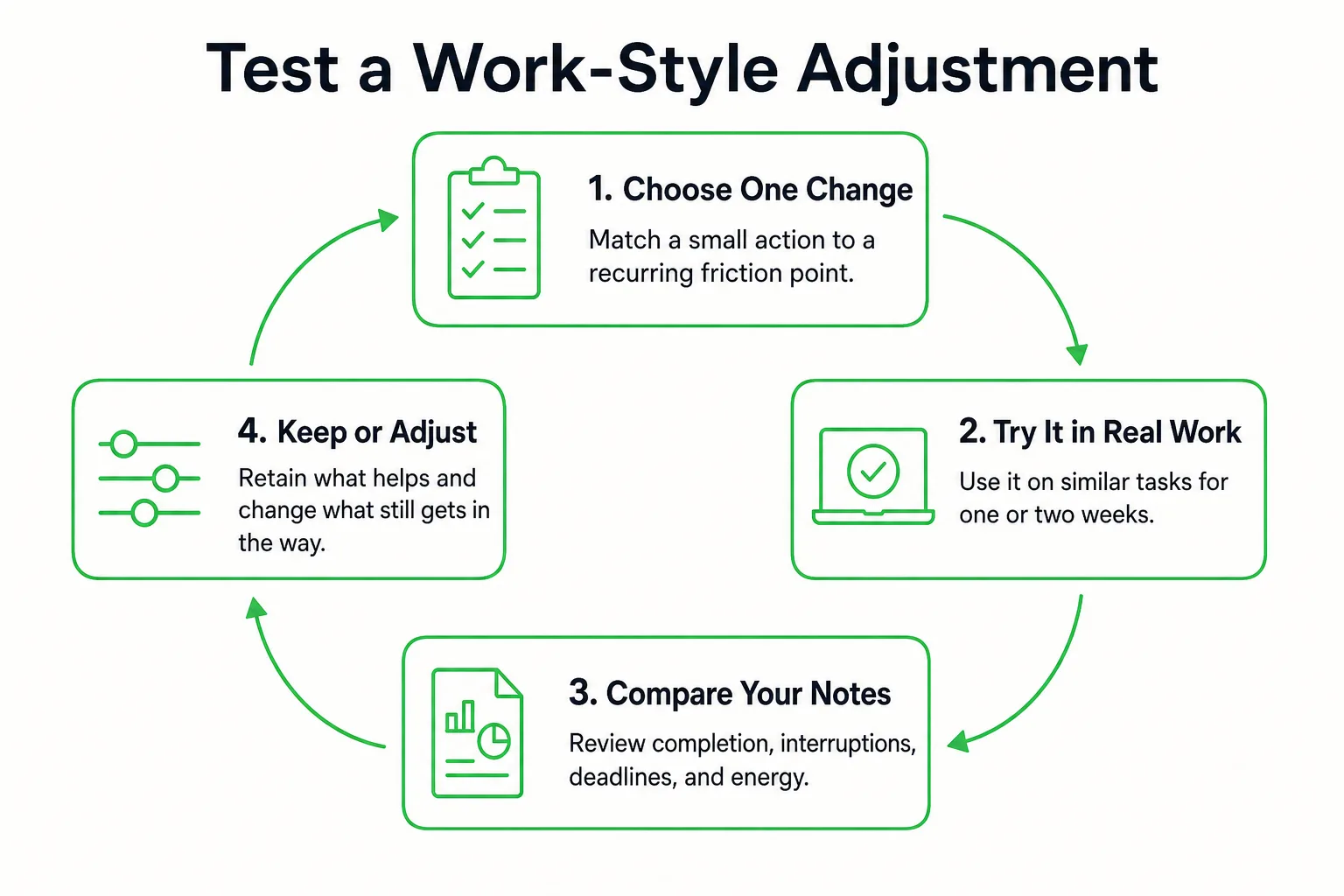
Write the test as an observable action: “For the next two weeks, I will send an update before the next person needs my draft.” If your intention is still broad, use the personal objectives for work examples to shape it into an action you can observe.
Use the previous workweek as a starting comparison if the tasks and workload were reasonably similar. If they were not, first collect observations across a few ordinary days. A heavier workload or an easier task mix can affect what you notice, so compare similar work where you can.
Track only the measures that relate to your change. You might record:
- Planned tasks left unfinished.
- Unplanned interruptions that changed your focus.
- Agreed deadlines you missed.
- Your end-of-day energy.
Keep the definitions steady throughout the test. Count a deadline as missed only when you did not meet the agreed date or time; if you and the other person renegotiate it, record that separately. Count a conversation as an interruption only when it was unplanned and changed your focus. A scheduled discussion is part of the work, not an unplanned interruption.
For energy, write low, medium, or high at the same point each workday. Add a short note when the workload, sleep, or task difficulty differs from usual. You can keep the habit you are testing and its related tasks in Loggd.
Before the test starts, plan for interruptions and decide how you will get back on track. Make this concrete by writing down the next action before switching away from the task. When you return, that note gives you a clear place to restart.
At the end of the test, compare similar tasks and ask whether the change addressed the original friction. Also check whether it created a new problem for you or your coworkers. Then choose one of three actions:
- Keep the change if it helped with the friction and fits the work.
- Adjust it if the idea is useful but its timing or size does not fit.
- Choose a different approach if the original friction remains.
Choose the habit you will retain for the following week.
Sources
- An Urgent Call to Address Work-related Psychosocial Hazards and Improve Worker Well-being
- Sleep and your health
- Healthy and fit on the go: Goal setting
- Multitasking: Switching costs